
Months to Years: 12 Exact Conversions Plus the 99 Months Example
Forms that ask for cumulative months leave parents stuck doing months to years math by hand. This guide shows the exact remainder method, a conversion table, and why 99 months is 8 years and 3 months — not “about 8.”
For authoritative background, see CDC Learn the Signs milestones. Practice live on Age in months calculator.
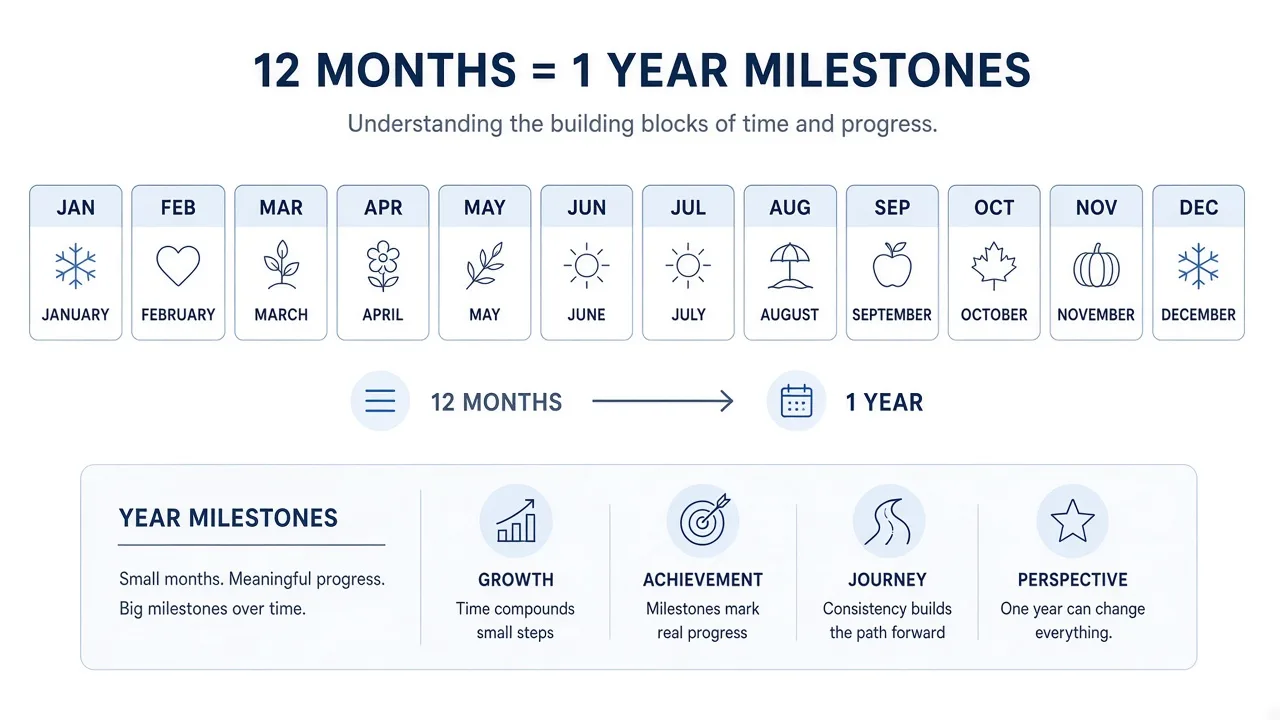
The Exact Months to Years Formula
To convert months to years, divide cumulative months by 12. The quotient is complete years; the remainder is leftover months. Example: 99 ÷ 12 = 8 remainder 3 → 8 years, 3 months.
Never round months to years for eligibility paperwork. Early intervention and some psychometrics bin by cumulative months, so months to years rounding can shift a child across a cutoff.
Write both forms on the page: months to years with remainder, and years-and-months back to cumulative months using (years × 12) + months.
Why Clinics Prefer Months Over Rounded Years
A child who is “8 years old” in birthday language may still be 99 months on a chart. Months to years translation prevents that mismatch when parents talk to therapists.
ASQ and similar screens schedule by month windows. Converting months to years only for conversation — then switching back to months for forms — keeps everyone aligned.
Chronological age calculators output years, months, and days. Use months to years only when a form forces a single cumulative-month field.
12 Exact Conversions You Will See on Forms
Keep a pocket table for months to years: 12→1y0m, 18→1y6m, 24→2y0m, 30→2y6m, 36→3y0m, 48→4y0m, 60→5y0m, 72→6y0m, 84→7y0m, 96→8y0m, 99→8y3m, 108→9y0m.
Print the months to years table next to your calculator so families verify the remainder instead of trusting mental math during a stressful intake.
When a portal only accepts integers, enter cumulative months and keep the months to years translation in the notes field for caregivers.
Worked Case: How Many Years Is 99 Months?
Searchers type “how many years is 99 months” constantly. The months to years answer is exact: 8 years and 3 months. Link that sentence to your dedicated 99-months explainer if you publish one.
Show the inverse: 8 × 12 + 3 = 99. Parents who only remember “eight” need the months to years remainder to fill cumulative fields correctly.
If a school asks for years only, clarify whether they want floor years (8) or a rounded age. Months to years policy differs by district — ask before you round.
Days, Rounding, and Protocol Quirks
Some Wechsler protocols treat 16+ days as another month. That is not a generic months to years rule — it is test-specific. Document the protocol name beside the age you report.
Leap days rarely change months to years remainders for school-age children, but they do matter for chronological age to the day. Use a dated calculator when days are required.
When in doubt, compute chronological age Y;M;D first, then derive cumulative months, then apply months to years for caregiver language.
Pearson and Other Named Calculators
People also search age calculator Pearson when they mean WISC/WAIS age bands. Months to years still sits underneath those branded tools as the simple conversion step.
If you maintain a Pearson alternative page, keep months to years language in an FAQ so the conversion cluster and the brand cluster reinforce each other without duplicate posts.
Always disclose you are unofficial. Official publisher manuals own scoring rules; months to years arithmetic is the portable skill families can check themselves.
Classroom and Therapy Scripts for Months to Years
Script: “Your child is 99 months, which is 8 years 3 months on the months to years conversion we use for this form.” Say both numbers every time.
Hand caregivers a one-page months to years card with the 12 common values. Reduce repeat calls about the same conversion.
For bilingual rooms, write months to years equations with digits only so language barriers do not hide the remainder.
Tools That Make Months to Years Instant
Use the age-in-months calculator on this site, then apply months to years with the remainder method above. Do not rely on phone calculators that only show decimals like 8.25 years.
Decimals hide remainders. 8.25 years is not how this topic appears on EI paperwork — they want 8 years 3 months or 99 months.
Bookmark this this topic guide next to your chronological age tool so intake staff stop reinventing the division each afternoon.
Write the dates, numbers, or steps on paper so you are not relying on memory when the next form or puzzle appears.
Short paragraphs help skimmers. Keep each idea to a few sentences, then move on to the next concrete example.
If a claim cannot be checked against a primary source or a live tool on this site, treat it as opinion until you verify.
Teachers, parents, and solo learners can use the same sequence; only the stakes and the time box change.
Frequently Asked Questions
How do you convert this topic?
Divide by 12. Quotient = years, remainder = months. Example: 99 ÷ 12 = 8 years 3 months.
How many years is 99 months?
Exactly 8 years and 3 months.
Should I round this topic?
Not for eligibility forms. Keep remainders or report cumulative months.
What about age calculator Pearson searches?
Those usually mean WISC/WAIS age bands. The underlying this topic math is the same remainder method.
Where can I calculate age in months?
Use the free age-in-months calculator on ChronoCalc, then convert this topic with this guide.
A practical checklist for this topic beats a slogan: define the term, show the math or steps, then list the caveats.
When you cite this topic in notes or lesson plans, keep the same phrasing so searchers and students land on the same idea.
If a claim about this topic cannot be checked against a primary source or a tool on this site, treat it as opinion until verified.
Bookmark this page if this topic is part of your weekly workflow; return after you test one tip live.
Teachers, parents, and solo learners can share the same sequence for this topic; only the stakes change.
Short paragraphs help skimmers, so each point about this topic stays focused and dated where prices or rules matter.
After you finish a section on this topic, jump to the related tools linked below and apply one idea immediately.
A practical checklist for this topic beats a slogan: define the term, show the math or steps, then list the caveats.
When you cite this topic in notes or lesson plans, keep the same phrasing so searchers and students land on the same idea.
If a claim about this topic cannot be checked against a primary source or a tool on this site, treat it as opinion until verified.
Bookmark this page if this topic is part of your weekly workflow; return after you test one tip live.
Teachers, parents, and solo learners can share the same sequence for this topic; only the stakes change.